
Tankless Water Heater Maintenance Tips
Tankless water heaters have gained popularity for good reason — they provide hot water on demand, take up far less space than traditional tank units, and can last 20 years or more with proper care. However, "with proper care" is the key phrase. Many homeowners assume that because tankless water heaters don't have a large tank of standing water, they require no maintenance. This is a common misconception that can lead to reduced performance, higher energy bills, and a shortened lifespan. Regular maintenance keeps your tankless water heater running at peak efficiency and helps you avoid costly repairs down the road.
Why Maintenance Matters
Even though tankless water heaters don't store water, they still face challenges from the water passing through them. The biggest enemy is mineral scale buildup, particularly in areas with hard water. As water is heated inside the unit's heat exchanger, dissolved calcium and magnesium precipitate out and form a crusty layer of scale on the heat exchanger surfaces. This scale acts as an insulator, forcing the unit to work harder to heat the water. Over time, scale buildup reduces efficiency, decreases flow rate, and can eventually damage the heat exchanger — the most expensive component of the unit.
Most manufacturers require regular maintenance to keep the warranty valid. If a heat exchanger fails and the manufacturer determines that the unit was not maintained according to their specifications, the warranty claim may be denied. Routine maintenance is a small investment that protects a much larger one.
Descaling: The Most Important Maintenance Task
Descaling (also called flushing or deliming) is the process of circulating an acidic solution through the heat exchanger to dissolve mineral scale deposits. This is the single most important maintenance task for a tankless water heater.
How Often to Descale
The frequency of descaling depends primarily on your water hardness. In areas with moderately hard water (7-10 grains per gallon), annual descaling is typically sufficient. In areas with very hard water (above 10 grains per gallon), descaling every six months may be necessary. If your home has a water softener, you may be able to extend the interval to every 18 to 24 months. Some modern tankless units have built-in error codes that alert you when scale buildup is affecting performance, which is a helpful indicator that descaling is overdue.
The Descaling Process
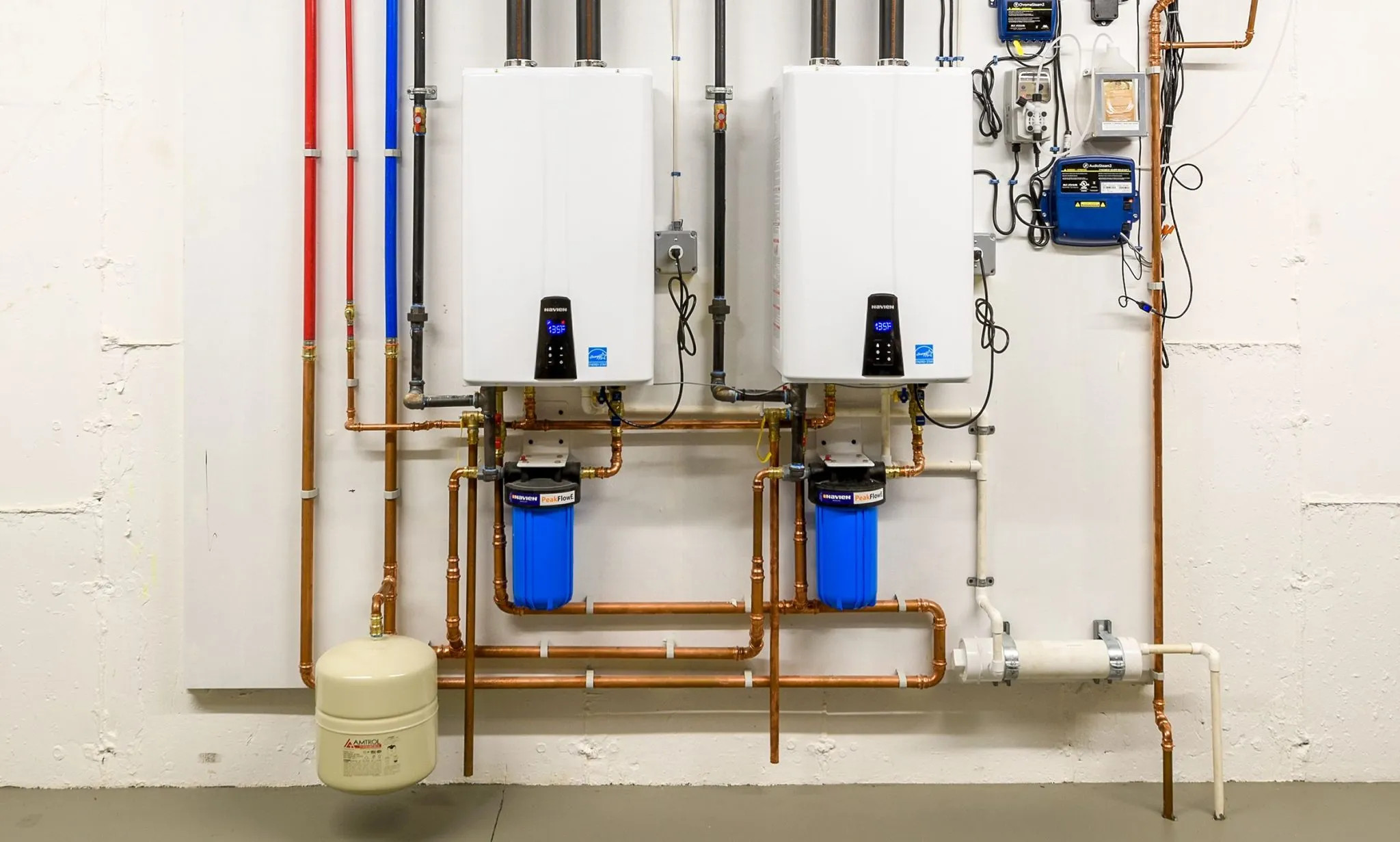
Professional descaling involves connecting a small submersible pump and a bucket of descaling solution (typically food-grade white vinegar or a commercial descaling product) to the unit's isolation valves. The pump circulates the solution through the heat exchanger for 45 minutes to an hour, dissolving the accumulated scale. The system is then flushed with clean water to remove any remaining solution and loosened deposits. While some handy homeowners perform this task themselves using a descaling kit, many prefer to have a professional handle it to ensure it's done thoroughly and correctly. If you're considering a new tankless unit or need service on your current one, our water heater services include both installation and ongoing maintenance.
Cleaning the Inlet Filter
Every tankless water heater has an inlet water filter (sometimes called a strainer or screen) that catches sediment and debris before they enter the unit. This filter is usually located at the cold water inlet connection and is easily accessible. Over time, the filter can become clogged with sediment, reducing water flow to the unit and potentially causing it to shut down or display an error code.
Cleaning the inlet filter is a simple task that should be done every six months or whenever you notice a decrease in hot water flow. Turn off the cold water supply to the unit, remove the filter (usually by unscrewing a small fitting), rinse it under running water to remove debris, and reinstall it. If the filter is damaged or heavily corroded, replace it with a new one from the manufacturer.
Inspecting the Venting System
Gas-powered tankless water heaters require proper venting to safely exhaust combustion gases. The vent pipe should be inspected annually to ensure it is in good condition and free of obstructions.
- Check for blockages: Bird nests, leaves, insect nests, or ice can obstruct the vent termination on the exterior of the home. A blocked vent can cause the unit to shut down for safety or, worse, allow carbon monoxide to back up into the home.
- Inspect for damage: Look for cracks, corrosion, or disconnected sections in the vent pipe. Any damage that could allow combustion gases to leak into living spaces requires immediate repair.
- Verify proper slope: Condensing tankless water heaters produce acidic condensate that must drain properly. The vent pipe should be sloped so that condensate flows toward the unit or an external drain point, not pooling in low spots.
- Check clearances: Ensure the vent termination maintains the required clearances from windows, doors, and air intake openings as specified in the installation manual and local building codes.
Additional Maintenance Tasks
Check the Condensate Drain
Condensing tankless water heaters produce condensate (slightly acidic water) as a byproduct of the high-efficiency combustion process. This condensate is typically routed to a floor drain or neutralizer. Check the condensate drain line periodically to ensure it is not clogged or blocked, and verify that the neutralizer cartridge (if installed) is not exhausted.
Test the Pressure Relief Valve
Like tank water heaters, most tankless units have a pressure relief valve as a safety feature. Test it annually by lifting the lever and verifying that water is discharged. If the valve is stuck or doesn't release water, it should be replaced immediately.
Monitor Error Codes
Modern tankless water heaters have digital displays or indicator lights that communicate error codes when something is wrong. Familiarize yourself with the common error codes for your specific model (found in the owner's manual) so you can quickly identify issues. Common codes relate to ignition failure, flame loss, exhaust blockage, and scale buildup. For a deeper dive into tankless water heater technology and selection, check out our guide to tankless water heaters.
Recommended Annual Service Schedule
To keep your tankless water heater in top condition, follow this annual maintenance schedule:
- Every 6 months: Clean the inlet water filter. Descale if you have very hard water.
- Annually: Perform a full descaling flush. Inspect the venting system. Test the pressure relief valve. Check the condensate drain (condensing models). Review any stored error codes. Clean the exterior and surrounding area of dust and debris.
- Every 3-5 years: Have a professional perform a comprehensive inspection of all internal components, including the burner assembly, ignition system, and gas connections.
Pro Tip: Install isolation valves (also called service valves) on both the hot and cold water lines to your tankless water heater if they aren't already installed. These valves make descaling dramatically easier because you can connect the flushing pump directly to them without disturbing any other plumbing connections. Many newer installations include these valves by default, but older installations may not.
Need tankless water heater maintenance? We've got you covered!